Come Clean logo

Harm
Reduction
Boxes

Design as Immediate Intervention

After losing two friends and later my mother to overdose, I stopped thinking about awareness and started thinking about access.

22
Boxes Installed SF
36
Requested & Pending
▶ Featured on KQED
JOSH YULE
CCA MDES
INTERACTION DESIGN

Loss became action

This work did not begin in a studio. It began with loss.

Over several years, I lost two close friends and later my mother to overdose. Their deaths changed the way I thought about harm reduction and left me asking a simple question:

What if the tools needed to save a life were already there when an emergency happened?

"Access does not guarantee presence in the moment of crisis."

Naloxone can reverse an opioid overdose in minutes. While it has become easier to access through pharmacies and community programs, it is often not available in the places where overdoses occur.

A naloxone kit sitting on a pharmacy shelf cannot help someone overdosing in a bar, music venue, or community space. The tools need to be present in the moment they are needed.

Harm Reduction Boxes grew from that realization. What started as a personal response to loss became an effort to place life saving resources directly into the spaces where people gather.

Photos of Josh's mother

From personal grief to public action

The project began as a personal act of mourning and became a public health intervention rooted in visibility, access, and community care.

02 · Design Process

From conversation to action

Before the boxes, there was a campaign. The Come Clean project began as a series of posters and coasters designed to start conversations about opioid use without shame. That work taught me something important: awareness matters, but awareness alone does not save lives. The next step was creating something people could use in an emergency.

GRAPHIC DESIGN II
Come Clean Campaign
Posters and coasters designed to reduce stigma and encourage conversation around opioid use in the places where people already gather.
THESIS · EARLY PROTOTYPE
First Harm Reduction Box
A hand built prototype explored a simple idea: what happens when life saving tools are placed where they are most likely to be needed?
SYSTEM DESIGN
Emergency Instructions
Simple, highly visible instructions designed to help someone respond quickly during an overdose emergency.
COMMUNITY DEPLOYMENT
22 Boxes Installed
Today, Harm Reduction Boxes can be found throughout San Francisco, providing access to naloxone, fentanyl test strips, and overdose response information.

Early Campaign Work

Graphic Design II · CCA

Destigmatize Opioid Abuse poster

Poster — Destigmatize Opioid Abuse

Coaster 01 — Opioid abuse is not disgraceful

Coaster 01 — Opioid abuse is not disgraceful

Coaster 02 — Opioid abuse is a disorder

Coaster 02 — Opioid abuse is a disorder. Let's Chat.

Building the System

Thesis Work · CCA MDes

Prototype specs — box dimensions and neon sign design

Prototype specs — 10"×20" box with neon sign design

First cardboard prototype

Very first prototype — built at home

First finished wooden box

First finished wooden box — CCA workshop

Peel Place Press instruction card

Custom instruction card — Peel · Place · Press

Harm Reduction Nasal Spray badge

Narcan badge — recreated for box familiarity

Access means nothing if it is not there

Most overdoses do not happen in hospitals. They happen in bars, music venues, galleries, and other social spaces where people gather.

In many overdose emergencies, bystanders are the first people on the scene. But knowing naloxone exists is different from having it within reach when seconds matter.

The time to respond is short. When people do not have the tools or confidence to act, lives can be lost before help arrives.

That gap between access and presence became the focus of this project.

More than 100,000 people die from drug overdoses each year in the United States. While recent numbers show progress, the crisis remains urgent.

The question was not whether naloxone works. The question was how to make sure it is present when it is needed.

U.S. Drug Overdose Deaths
Source: CDC · NCHS · National Vital Statistics System
2021106,699 ▲
2022107,941 ▲
2023107,543 ▶
202480,499 ▼ −27%
Harm reduction is working.
But every gap in access is a life at risk.
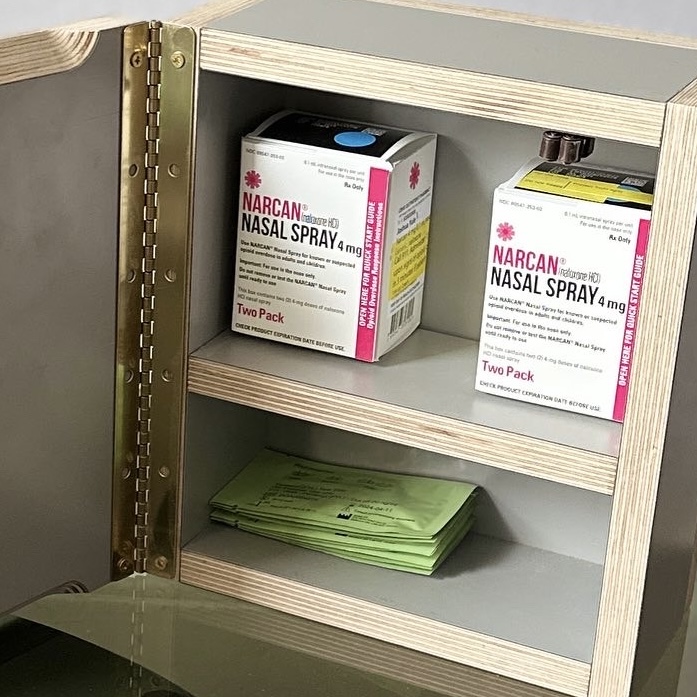
Box contents — Narcan and fentanyl test strips
Box installed in bar
04 · The Solution

Put life saving tools where people already gather

Harm Reduction Boxes are hand built enclosures that contain naloxone, fentanyl test strips, and simple overdose response instructions. They are installed directly in bars, music venues, galleries, and community spaces where immediate access can make a difference.

Narcan (Naloxone)

Two doses per box. Naloxone is a safe medication that can reverse an opioid overdose and give someone a second chance at life.

Fentanyl Test Strips

A simple tool that helps people identify fentanyl before use. Prevention is just as important as response.

Peel · Place · Press

A simple three step instruction card designed to help someone act quickly and confidently during an overdose emergency.

Five Design Principles

01
Visibility
02
Accessibility
03
Simplicity Under Stress
04
Community Ownership
05
No Judgment
05 · In The Wild

22 boxes, San Francisco

Assembled by hand and installed at nightlife establishments across San Francisco — wherever the chance of an opioid overdose inside or nearby is probable. Each box is placed in a highly visible common area where employees and patrons can interact with it conversationally, or in a worst-case scenario, use it to administer life-saving naloxone.

Access Action

People notice the box.
A conversation starts.
Someone feels prepared.
Access becomes action.
▶ Watch the Interviews on YouTube Chloe · Johanna · Richard — in their own words
07 · Press & Outreach

The story found an audience

"Harm-reduction boxes offer 'a beacon for conversation.' That push to reduce stigma and save lives is why Josh Yule has been building harm-reduction boxes and delivering them to bars since December. The bright, medical-white boxes contain Narcan; a neon pink, three-step guide to administering it; and fentanyl test strips."
▶ Read the KQED Article
KQED slide 1
KQED slide 2
KQED slide 3
KQED slide 4
KQED slide 5

KQED Social Media Carousel · @kqed

Art that belongs to the community

The boxes aren't purely functional — they're community artifacts. The artist component was never decorative; it was strategic. A plain white box is easy to overlook. A box painted by a local artist becomes a conversation, a landmark, a signal of community care.

"The artwork transforms the boxes from emergency objects into community interventions — reducing stigma, creating ownership, and making the invisible visible."

Artist Jay Howell — best known as the illustrator behind the distinctive visual world of Bob's Burgers — completed a custom box door for 111 Minna Gallery in San Francisco. His involvement signals the kind of community reach this project can achieve: when artists with real cultural weight say yes, the boxes become more than emergency tools. They become landmarks.

Jay Howell · 111 Minna Gallery Chelsea Wong Open Artist Network →
Artist Program
2
Artists have contributed custom box designs — growing toward an open artist network across SF and beyond.
Each box belongs to the community it lives in.
SOMArts logo
▶ Fiscal Sponsorship
SOMArts Cultural Center
A fiscal sponsorship partnership with SOMArts in San Francisco — enabling grant applications, impact award submissions, and institutional funding for Harm Reduction Boxes.
Jay Howell custom artwork
Artist Collaboration
Jay Howell
111 Minna Gallery · San Francisco
Chelsea Wong box at The Phonebooth Bar
Artist Collaboration
Chelsea Wong
The Phonebooth Bar · San Francisco
09 · Impact & Metrics

What has actually happened

22
Boxes installed across San Francisco
36
Additional boxes requested & pending
Lives — Narcan from boxes used in real overdose reversals
KQED
Bay Area public media + growing community partnerships

Narcan from installed boxes has been used in overdose reversals. A person is alive today because the right tool was in the right place at the right moment.

Beyond reversals, the boxes function as designed: creating conversation, reducing hesitation, and transforming bystanders into responders — across bars, music venues, galleries, and community spaces throughout San Francisco.

10 · Future Vision

Building for growth

▶ Evolve

Meet Demand

Build and install the 36 currently requested boxes. The demand is real and already here.

▶ Extend

Scale Beyond the Bay

Develop a replicable deployment model for other cities and organizations to adopt independently.

▶ Connect

Partner to Grow

National Harm Reduction Coalition, Hospitality House, #EndOverdose, The Dope Project, arts orgs, public health groups.

▶ Carry

Portable Solutions

Explore compact, leash-mounted or everyday-carry Narcan holders — bringing harm reduction into everyday life.

The cost of a life-saving tool

Each box is hand-built from materials costing less than a midrange restaurant meal.

$113Per box complete
$4,068Total for all 36 pending boxes

What design can do when it has stakes

This project asked the hardest question a designer can face: What do you do when the thing you care about most is also the problem you're trying to solve?

Harm Reduction Boxes is not a portfolio project about a social issue. It's a living intervention built from personal loss. The boxes are installed. They have been used. They continue to grow.

That changes how I think about design.

The most important part of this project is not the object itself. It is the trust, visibility, and willingness to act that the object creates.

Design cannot solve every problem. But it can remove barriers. It can create access. And sometimes, it can help put the right tool in the right place at the right moment.

Design can close the gap between access and presence. Between a tool that exists somewhere — and a tool that's there, right now, when someone needs it most.
Finished Harm Reduction Box open showing contents